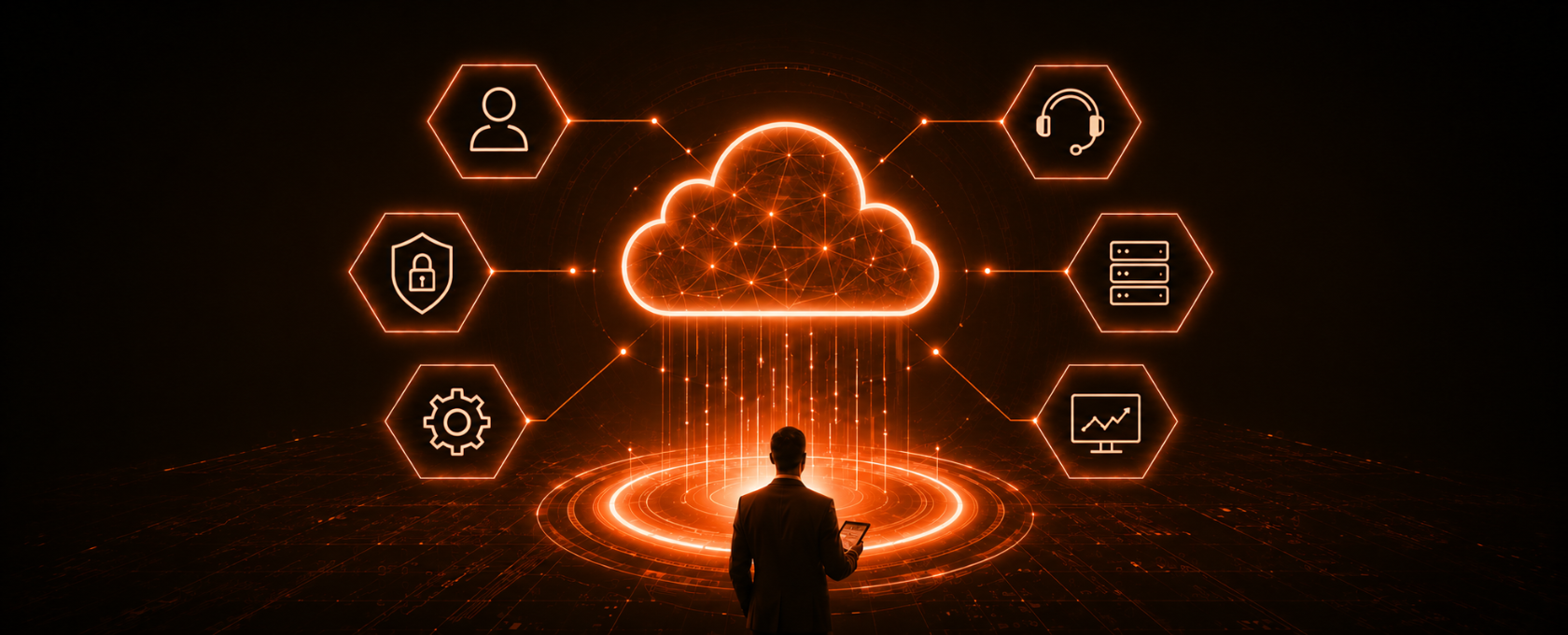























A majority of the legacy environments I come across are not poorly constructed, but simply made for a different time. Companies are now updating their infrastructure because the previous configuration can no longer comply with their needs, as it lacks scalability, agility, and has too many rising security problems. Cloud modernization is wrongly seen as equivalent term to migration, and I observe it on a constant basis. Moving workloads to the cloud and modernizing them represent two distinct processes that can lead to significant financial losses if companies don’t understand their difference.
Managed IT services play a vital role in the context of modernization. It is necessary to understand that modernization is not a weekend project; it should be considered a comprehensive process that requires time and expertise. In this article, I would explan you the concept of complete cloud modernization and how managed IT services help in accelerating the modernization process.
What Is Cloud Modernization?
Cloud modernization refers to the process of transforming systems and infrastructure so that they can benefit from the cloud. Traditional cloud migration generally refers to simply moving items from one place to another. Techniques for modernization differ greatly from one another.
- Rehosting: lift and shift, fastest but least transformative
- Replatforming: small tweaks for better cloud fit
- Refactoring: rewriting parts of the code for cloud native behavior
- Rebuilding: starting fresh, most disruptive but often most rewarding
Companies modernize because the old way of doing things is more expensive, slower, and more prone to failure.
Why Businesses Need Managed IT Services for Cloud Modernization?
The fact is that too many in-house teams lack the necessary resources since cloud modernization involves such skills that most companies do not possess. Legacy applications are complex and very complicated, with various dependencies that they didn’t document properly. In order to simplify this situation, proper skills and knowledge are required. Moreover, due to various security and compliance requirements as well as cost, organizations have decided to seek help from managed service providers and not attempt to manage everything internally.
- Specialized cloud expertise is hard to hire and harder to retain
- Legacy app complexity slows everything down
- Security and compliance can’t be an afterthought
- Cost creep happens fast without active management
- Continuous monitoring needs coverage internal teams rarely have
- Internal IT gets buried if it tries to do modernization and daily operations at once
Key Components of End-to-End Managed IT Services for Cloud Modernization
1. Cloud Readiness Assessment
Before the project proceeds, one needs to know about what is presently available, including hardware, software, applications, and the workloads. Relationships, dependencies and chances for modernization have to be identified. Be true and fair about what can be done, and what cannot.
2. Cloud Strategy and Roadmap
Determine what the organization hopes to achieve, which is not just speedier hardware but tangible results. Choose technologies that suit, select workloads based on contribution to the business, and draw a staged cloud migration roadmap.
3. Application Modernization
This is the process in which legacy applications can be modified for new cloud environments. It can be large or small modifications in some cases called the refactoring stage. Containers and microservices are being introduced when using them makes sense in terms of business. The key aim of such modifications is getting improvements in terms of performance and scalability.
4. Cloud Infrastructure Modernization
Modern infrastructure should be able to scale and recover on its own without a constant oversight from humans. Infrastructure as Code allows for an automated provisioning process that is consistent and repeatable rather than manual and prone to human error. The modernization of networking, storage, and computing takes place all at once because performing it separately creates more problems than it solves.
5. Cloud Migration and Implementation
There needs to be proper planning of the migration process in order to avoid losses caused by downtime, which can cost money and damage reputation. Applications and infrastructure must be tested after migration and not just accepted as working. Both hybrid and multi-cloud solutions are implemented where the business genuinely needs them, not just because it sounds impressive.
6. Cloud Security and Compliance
Identity and access management is first because it is where most incidents occur. Data and workloads require actual protection instead of just being a part of a list. Security monitoring and threat detection operate around the clock; compliance standards are integrated rather than added later on to something.
7. DevOps and Automation
CI/CD pipelines speed up releases and are also less prone to human errors resulting from manual procedures. Provisioning and deployment processes of Infrastructure gets automated. And all of these are connected and executed thanks to the Infrastructure as Code concept. Thus, continuous releases happen instead of the usual stressful ones on Fridays.
8. Managed Cloud Operations
This is the part that runs quietly in the background, 24 by 7 monitoring, incident management, performance tracking. Backup and disaster recovery get tested, not just documented and forgotten. Patch and configuration management stay current instead of piling up into a future emergency.
9. Cloud Cost Optimization
Cloud expenses are tracked closely, as idle resources get depleted and expensive quickly. FinOps helps one to be more aware of the expenses instead of guesswork. Optimizing process needs to be an ongoing task.
10. Continuous Optimization and Support
It is important to monitor modernization processes after they are implemented and not just celebrated. Opportunities for improvement keep appearing in time as business changes. Ongoing technical support and cloud expertise keep the environment moving forward instead of slowly drifting backward.
Benefits of End-to-End Managed IT Services for Cloud Modernization
The value compounds when all these pieces work together instead of separately.
- Faster modernization timelines
- Less operational complexity
- Better scalability and performance
- Stronger security and compliance posture
- Tighter cloud cost control
- Access to specialized expertise without the hiring headache
- Less pressure on internal IT teams
- Continuous optimization instead of a one-time project
How Blazeclan Managed Services Can Help With Cloud Modernization
Blazeclan works towards modernization in a complete cycle, not just components of it. In other words, the services comprise assessment, strategizing, applications and infrastructures modernization, migration and implementation, and follow-on activities such as managed services, security, DevOps, and cost optimization. Unlike competitors, Blazeclan does not end the job after putting the new environment in place, but continues working on maintenance, which constitutes the key to successful implementation of modernization.
Conclusion
Cloud modernization doesn’t end when the last workload finishes migrating, that’s honestly where the real work begins. Companies considering cloud modernization as one-time project are likely to suffer setbacks. By that, we refer to the business that requires continuous work, 24/7 security, and constant optimization and support. If your business seeks a true partner in the field of cloud management from start to finish, Blazeclan possesses all necessary experience and competencies to ensure success in the project and its support.
Also Read: